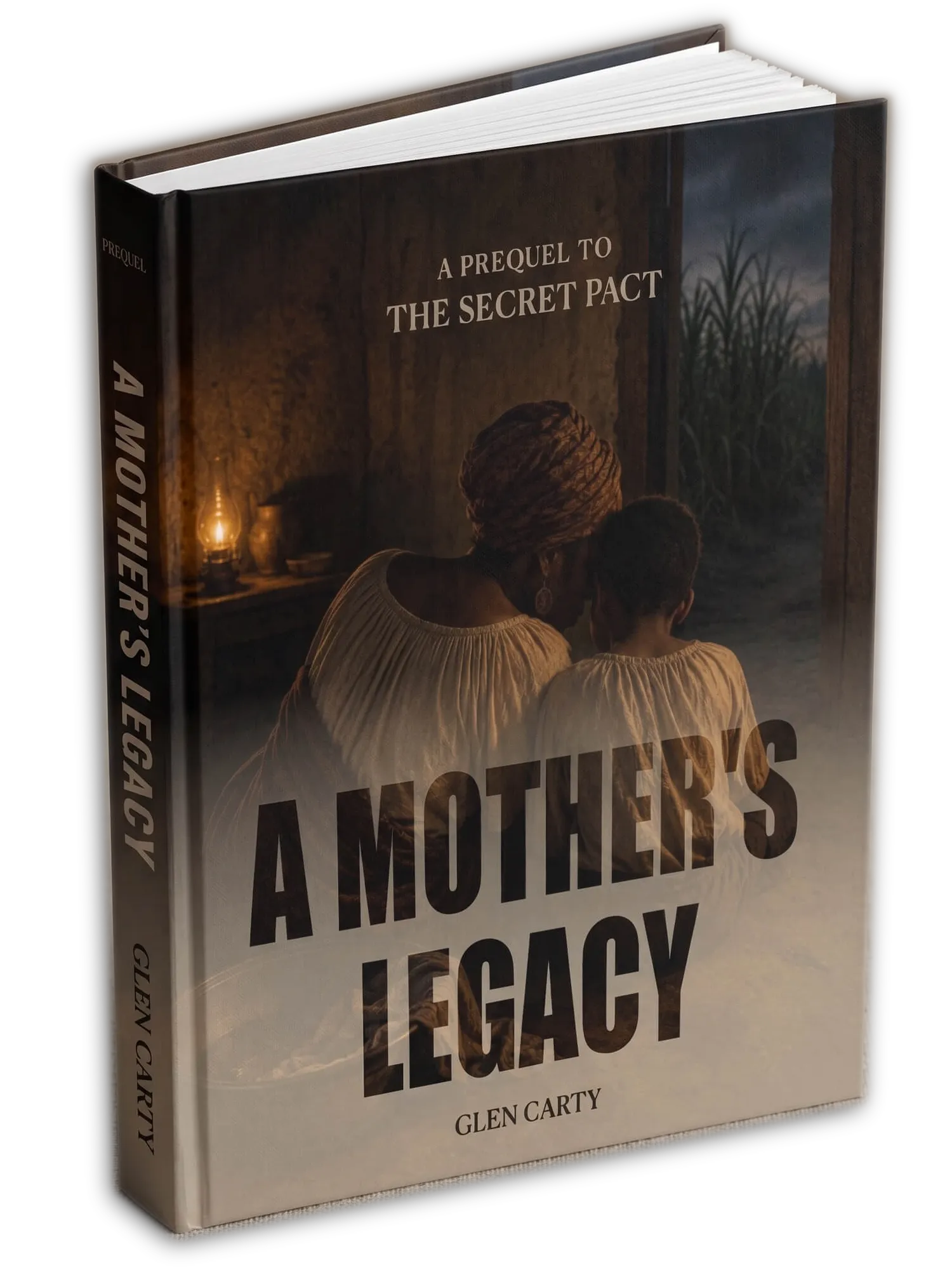
A Mother's Legacy
Book 2 of The Secret Pact Series
Beyond the dry ink of colonial ledgers lies a story of survival. Journey to 1740 Jamaica, where a mother’s secret becomes a son’s inheritance.
 Official Entry: Kindle Storyteller Award 2026
"...we will not permit, nor allow to go there [to the Americas] Moors nor Jews nor heretics... except if they are black slaves, or other slaves, that have been born under the dominion of our natural Christian subjects."
— Spanish Crown decree
The forced movement of Africans into the Caribbean did not begin with the British conquest of Jamaica in 1655. By the early 1500s, Spanish policy had already opened the door to African slavery in Jamaica and across the Americas.
A Mother's Legacy
A tale of a girl captured, stolen, marched, and carried across the sea into a New World. She has no agency, no say in her fate. Years later, she shares her story with her nine-year-old son. It is the only way she can tell him who she was, what she lost, and by extension, who he must be. Her words shape the person he becomes: a man whose life and liberty others will risk everything to protect — and to some, a man whose very survival must be crushed.
Book Review
A Mother’s Legacy
The Haunting Prequel to The Secret Pact
The History Beneath the Fiction
In the shadow of the 1739–40 Maroon Treaties, freedom and captivity stood dangerously close. The treaties secured peace for the Maroons, but left the enslaved outside their protection. A Mother's Legacy serves as a narrative bridge, giving voice to the people history tried to bury.
For thousands upon thousands of Africans, the ship’s destination was Jamaica.
Jamaica became one of the most important slave societies in the British Atlantic. Its plantation economy, especially its sugar economy, consumed labor at a devastating rate. High mortality, brutal work, disease, punishment, poor living conditions, and the demands of plantation production meant that planters continued to rely heavily on new arrivals from Africa.
Kingston became central to that system. After the destruction of Port Royal in the 1692 earthquake and Kingston’s growth in the decades that followed, the town developed into Jamaica’s major commercial port. By the late eighteenth century, it was not only a place of warehouses, wharves, merchants, sailors, taverns, and trades. It was also one of the major receiving points for enslaved Africans in the British Caribbean.
The moment of arrival brought no freedom. It opened a deeper stage of captivity.
"I wrote this to explore the long view of history — the lives, memories, and human costs that remain long after the ink on the treaties has faded."
Explore the Research
This project is part of a broader archival initiative. To understand the chronological development of this era, visit our primary resources: